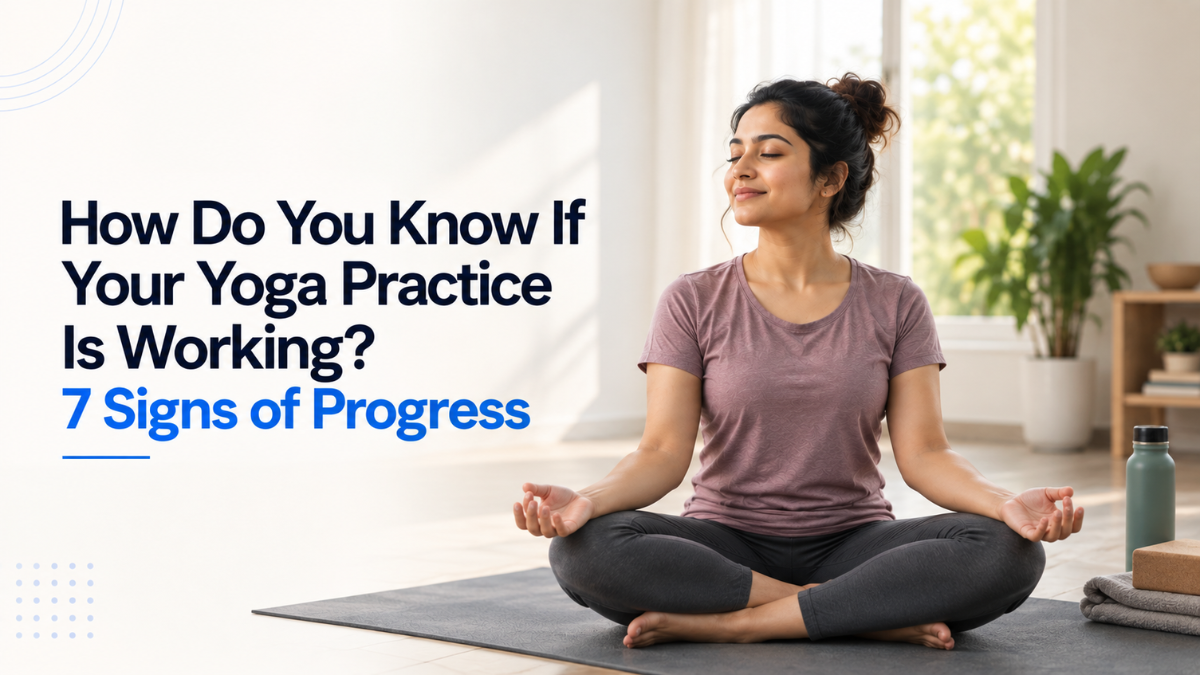
How Do You Know If Your Yoga Practice Is Working? 7 Signs of Progress
Yoga progress isn’t always about becoming more flexible or mastering difficult poses. Sometimes, the biggest changes are the ones you notice in everyday life.
You’ve been practising yoga for a few weeks.
Maybe you’re still not able to touch your toes.
That difficult pose you saw online still feels impossible.
And you start wondering:
“Is this actually working?”
It’s a very normal question.
When we start something new, we naturally look for visible results.
We want to bend further.
Hold a pose longer.
Become stronger.
Feel more flexible.
But yoga doesn’t always show progress in such obvious ways.
Maybe getting up from the floor feels a little easier.
Maybe your shoulders don’t feel as tight after work.
Maybe you notice your breathing more.
Or maybe you simply feel a little calmer at the end of the day.
Those changes count too.
Why Yoga Progress Can Be Hard to Notice
Yoga isn’t usually working on just one thing.
Depending on your practice, you may be working on:
- flexibility
- strength
- balance
- breathing
- mobility
- body awareness
- relaxation
And these don’t necessarily improve at the same speed.
You might notice better balance before better flexibility.
Your breathing may improve before you feel physically stronger.
You may become more comfortable in a pose without being able to go much deeper into it.
Progress doesn’t always look dramatic.
Sometimes it’s simply noticing that something feels a little easier than it did before.
7 Signs Your Yoga Practice May Be Working
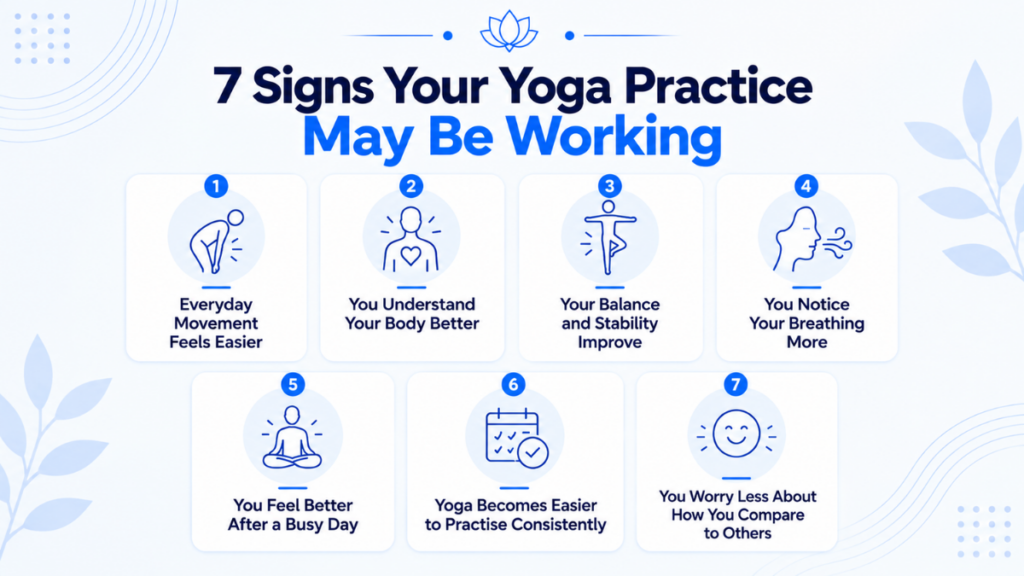
1. Everyday Movement Feels Easier
One of the first signs of progress may have nothing to do with your yoga mat.
You notice that:
- bending down feels easier
- getting up feels more comfortable
- reaching overhead feels less restricted
- your body doesn’t feel as stiff after sitting
These changes can happen so gradually that you barely notice them.
But they’re meaningful.
Yoga isn’t only about what you can do during a session. It’s also about how comfortably you move through everyday life.
2. You Understand Your Body Better
When you first start yoga, you may spend a lot of time wondering:
“Am I doing this right?”
You watch the teacher.
You look at other people.
You try to copy the position.
But with practice, something starts changing.
You become more aware of:
- where you feel tension
- when you’re pushing too hard
- how your body responds to different movements
- when you need to slow down
That awareness is progress.
You don’t have to perform every pose perfectly to become better at yoga.
Understanding your own body is a valuable part of the practice.
3. Your Balance and Stability Improve
Balance often improves gradually.
Maybe you used to lose your balance immediately in a standing pose.
Now you can hold it for a few more seconds.
Maybe you still wobble.
That’s completely fine.
Being able to recover from a wobble is progress too.
With regular practice, you may become more aware of how your body is positioned and how you distribute your weight.
That awareness can also become useful in everyday movement.
4. You Notice Your Breathing More
This is one of the quieter signs of progress.
You start noticing when you’re holding your breath.
You recognise when your breathing becomes shallow during stressful moments.
And sometimes, you naturally take a slower breath instead of immediately reacting.
It may not sound like a big change.
But becoming aware of your breath can change how you experience your day.
You are beginning to notice what’s happening inside your body instead of simply moving through the day on autopilot.
That’s progress too.
5. You Feel Better After a Busy Day
Yoga won’t remove deadlines, difficult conversations or stressful days.
But you may notice that you recover from them differently.
Perhaps a short practice helps you transition out of work mode.
Maybe a few minutes of breathing helps you settle down.
Or you simply recognise that your body needs a break instead of continuing to push through exhaustion.
Sometimes progress means knowing when to slow down.
6. Yoga Becomes Easier to Practise Consistently
At the beginning, you may have to convince yourself to practise.
You think:
“I’ll do it later.”
Then later becomes tomorrow.
But gradually, yoga can become part of your routine.
You don’t need quite as much motivation to begin.
You simply know:
“This is when I practise.”
That shift is important.
Progress isn’t only about what your body can do.
It’s also about building a practice you can realistically maintain.
If you find consistency difficult, our article on why group yoga classes often work better than practising alone explores how structure and accountability can help.
7. You Compare Yourself Less
This may be one of the biggest signs of progress.
In the beginning, it’s easy to look around.
Someone is more flexible.
Someone can hold a difficult pose.
Someone seems completely comfortable.
And you start wondering why your practice doesn’t look like theirs.
But over time, you may start thinking differently.
You become less interested in how your pose looks and more interested in how it feels.
You stop forcing yourself.
You start listening.
Your practice becomes less about proving something and more about understanding yourself.
That’s a meaningful change.
What If You Don’t Notice Any Big Changes Yet?
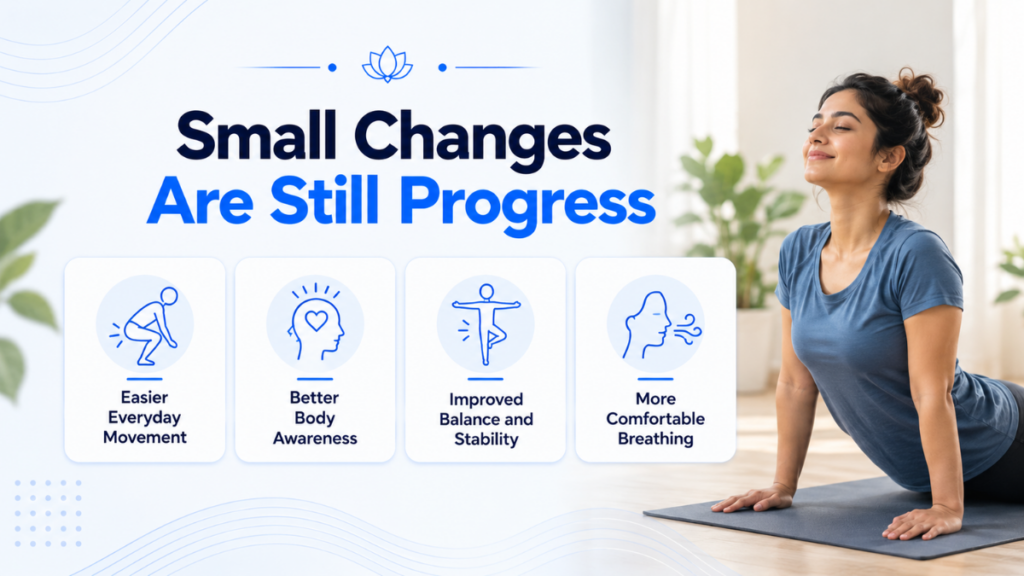
Don’t assume that nothing is happening.
Your body may still be learning the movements.
Your breathing may still feel unfamiliar.
You may still be figuring out what kind of practice suits you.
That’s normal.
Instead of asking:
“Why can’t I do more?”
try asking:
“What feels a little easier than it did before?”
Maybe you can sit more comfortably.
Maybe you remember to breathe.
Maybe you’re less nervous in class.
Maybe you’ve practised more consistently this month.
Small changes are still changes.
What Yoga Progress Is Not
Progress doesn’t have to mean:
- touching your toes
- doing advanced poses
- practising for an hour
- becoming extremely flexible
- keeping up with someone else
Those can be personal goals if you genuinely want them.
But they aren’t the only ways to measure progress.
A better yoga practice isn’t necessarily the one that looks more impressive.
Sometimes it’s the one that feels more comfortable, sustainable and natural.
How Can You Track Your Progress?
Every few weeks, take a moment to check in with yourself.
Ask:
- Do I feel less stiff?
- Is movement becoming easier?
- Am I more aware of my breathing?
- Do I feel more comfortable during practice?
- Am I handling stressful moments differently?
- Am I practising more consistently?
- Do I feel more connected to my body?
You don’t need to answer “yes” to everything.
Even one small change is worth noticing.
The Most Important Sign of Progress
There may be one sign that matters more than all the others:
You keep coming back.
You don’t have to practise perfectly.
You don’t have to feel motivated every day.
You don’t have to master every pose.
You simply return to your practice.
Some days will feel easy.
Some won’t.
Some days you’ll feel strong.
Other days you’ll need to slow down.
That’s part of yoga too.
Final Thoughts
Yoga progress isn’t always something you can see in a mirror.
Sometimes it’s the way you move.
Sometimes it’s the way you breathe.
Sometimes it’s the way you respond when your day becomes stressful.
And sometimes, it’s simply realising that you are no longer as hard on yourself as you used to be.
You don’t have to become the most flexible person in the room to know that your yoga practice is working.
If your body feels a little more comfortable, your mind a little more settled, or your practice a little more natural than before, you’re already moving forward.
Give yourself credit for the small changes.
They may be bigger than you realise.
Frequently Asked Questions
How do I know if my yoga practice is working?
Signs of progress can include easier everyday movement, improved balance, greater body awareness, more comfortable breathing, better consistency, and feeling calmer during daily activities.
How long does it take to see results from yoga?
There isn’t one timeline for everyone. Some changes may be noticeable relatively early, while others develop gradually with regular practice. Your starting point, practice frequency and goals all matter.
Does yoga progress always mean becoming more flexible?
No. Flexibility is only one measure of progress. Better balance, strength, body awareness, breathing, consistency and comfort in everyday movement can all be meaningful signs.
Can I make progress with 15–20 minutes of yoga a day?
Yes. A short, consistent practice can be a practical way to build your yoga habit. You don’t need long sessions every day for your practice to be meaningful.
What if I don’t see physical changes from yoga?
Physical changes can take time and vary from person to person. Yoga can also create changes that aren’t immediately visible, such as improved mobility, balance, body awareness and relaxation.
Should I compare my yoga progress with other people?
It’s better not to. Everyone starts with a different body, experience level and lifestyle. A more useful comparison is how you feel today versus when you started.
What if I miss a few days of yoga?
That’s okay. Missing a few sessions doesn’t erase your progress. Simply return when you’re ready and continue from where you left off.