

How Yoga Helps Improve Focus for Students and Working Professionals

Yoga for focus can be especially helpful when your mind feels distracted, tired, or overloaded. Have you ever sat down to study or finish some important work… and within a few minutes, your mind starts going somewhere else?
You open your laptop, start reading your notes, or begin working seriously, but then:
- You pick up your phone
- Your thoughts keep wandering
- You read the same line again and again
- Or you suddenly feel mentally tired for no reason
This has become very common today.
Students find it hard to stay focused during long study hours. Working professionals feel mentally exhausted before the day even ends. And many people feel bad about being “unproductive” even when they are trying their best.
But most of the time, the problem is not laziness.
The mind is just tired.
That’s where yoga can help, not by forcing focus, but by helping the mind and body slow down a little.
Why Is It So Hard to Focus Today?

These days, our attention is constantly getting pulled in different directions.
Most people wake up and immediately start checking:
- notifications
- emails
- reels
- messages
- work updates
- social media
Even while studying or working, the brain keeps jumping between different things.
One minute you’re working.
The next minute you’re replying to a message.
Then suddenly you forget what you were doing in the first place.
Doing this all day can make the mind feel tired and distracted.
That’s why so many people today deal with:
- short attention span
- brain fog
- mental tiredness
- feeling restless
- difficulty staying focused
The mind isn’t weak. It’s just overloaded.
Can Yoga Really Help With Focus?
Yes — and not only because of stretching or exercise.
Yoga also helps the body relax and slows down racing thoughts.
When the body starts feeling calm, the mind usually follows.
That’s why many people feel lighter or mentally fresh after yoga, even if the session was short.
Instead of forcing yourself to “focus harder,” yoga helps your mind slow down so that focusing starts to feel easier on its own.
This can especially help:
- students preparing for exams
- people working long hours
- people dealing with stress
- anyone who feels mentally distracted most of the time
How Yoga for Focus Can Help Naturally
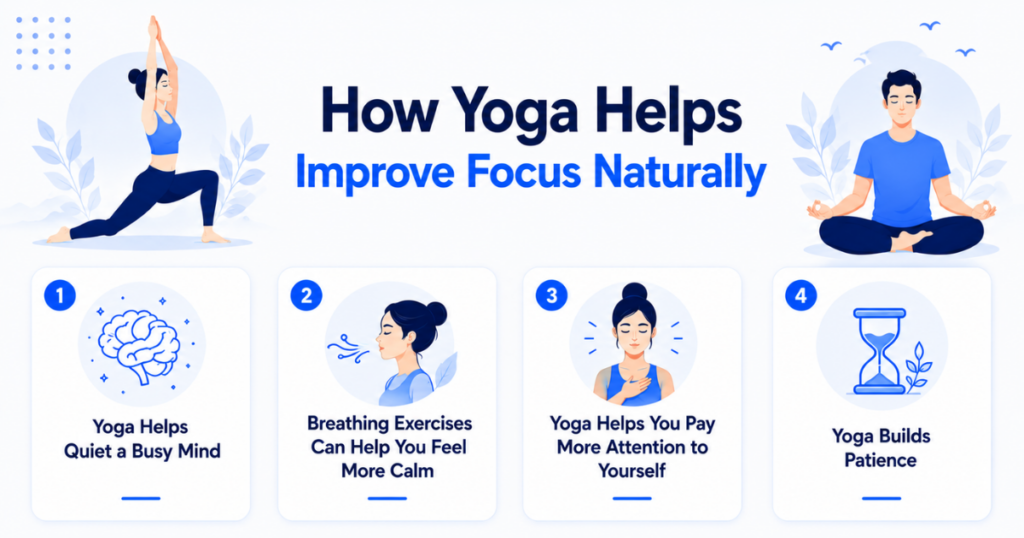
1. Yoga Helps Quiet a Busy Mind
One big reason people struggle with focus is that their mind never really gets a break.
Even while sitting quietly, thoughts keep running.
Yoga combines movement and breathing, which helps slow things down a little.
Simple things like:
- stretching
- slow breathing
- gentle movement
- sitting quietly for a few minutes
can help the mind feel more relaxed.
And when the mind feels calmer, focusing becomes easier too.
2. Breathing Exercises Can Help You Feel More Calm
Have you noticed how breathing changes when you feel stressed?
It becomes fast and shallow without you even realizing it.
That’s why breathing is such an important part of yoga.
Simple breathing practices like Anulom Vilom or Bhramari Pranayama can help the mind feel quieter and more relaxed. Many people feel less distracted and a little more focused after practicing them for a few minutes.
Even taking a few slow breaths before studying or starting work can help you settle your mind a little.
3. Yoga Helps You Pay More Attention to Yourself
Most people spend the entire day on autopilot.
Sometimes you don’t even notice:
- how tight your shoulders feel
- how tired your eyes are
- or how distracted your mind has become
Yoga helps bring your attention back to the present moment.
During practice, you slowly start noticing:
- your breathing
- your posture
- your movements
- and how your body feels
Over time, this can make it easier to notice distractions and bring your attention back faster.
4. Yoga Builds Patience Too
Focus is not only about intelligence.
A big part of the focus is learning how to stay with one thing without getting distracted every few minutes.
Yoga slowly teaches this habit.
You learn to slow down.
You stay connected to your breathing.
You move with patience instead of rushing.
And after some time, many people notice this habit showing up in daily life too.
They feel:
- calmer during stressful situations
- less irritated
- more steady while working
- better at handling distractions
Not because yoga magically fixes everything overnight — but because it helps the mind feel more settled over time.
Why Yoga Helps Students
Students today deal with a lot mentally.
There are:
- exams
- assignments
- pressure to perform
- long screen time
- constant distractions
It’s easy to feel mentally exhausted.
Yoga can help students slow down and relax a little during busy study routines.
Even a short daily practice may help with:
- better focus
- feeling less stressed
- a calmer mind
- healthier study breaks
- feeling mentally fresher
It can also help reduce body tightness from sitting for long hours.
Why Yoga Helps Working Professionals
For many working professionals, poor focus comes from mental exhaustion.
Long hours on the laptop, meetings, deadlines, multitasking, and nonstop notifications can drain the mind.
That’s why many people struggle with:
- brain fog
- low energy
- irritation
- difficulty concentrating
Yoga helps create small moments of rest during busy days.
Things like:
- desk stretches
- breathing exercises
- short yoga breaks
- relaxing evening stretches
It can help the mind feel refreshed again.
And honestly, even 10–15 minutes can make a difference sometimes.
A Common Mistake People Make
When focus becomes weak, many people try to push themselves harder.
They:
- work longer hours
- drink more caffeine
- multitask even more
- force themselves to stay productive
But sometimes the mind doesn’t need more pressure.
Sometimes it just needs:
- proper rest
- movement
- slower breathing
- quiet time
- a small mental break
That’s one reason yoga feels helpful for so many people.
It helps you slow down instead of constantly pushing yourself.
Simple Yoga Practices That May Help With Focus
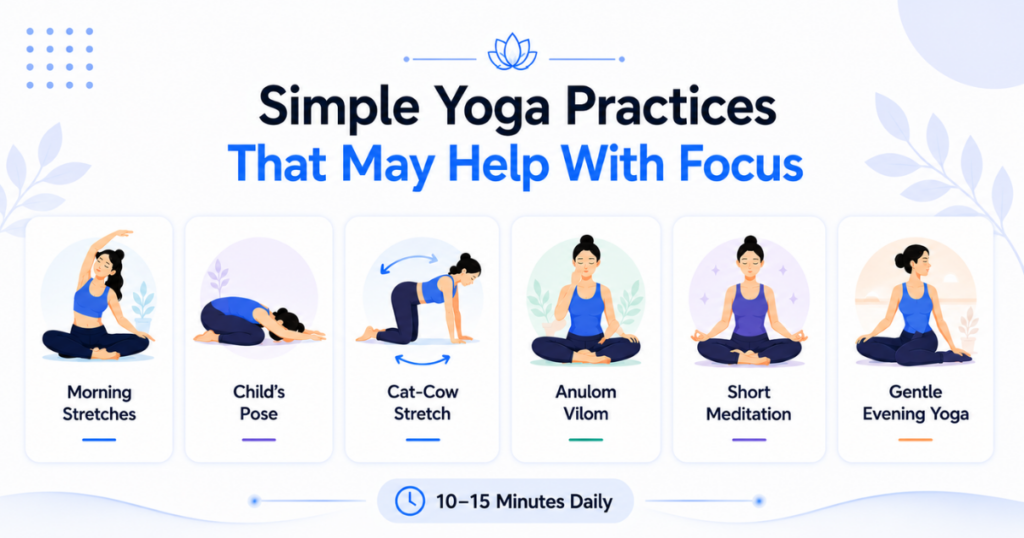
You do not need difficult yoga routines to start feeling the benefits.
You can begin with small things like:
- morning stretches
- child’s pose
- cat-cow stretch
- Anulom Vilom
- short meditation
- gentle evening yoga
The important thing is doing it regularly.
Even 10–15 minutes a day can slowly help the mind feel calmer and more focused.
Final Thoughts
Staying focused has become difficult for many people today.
And most people are not struggling because they are lazy.
Their minds are simply tired from constant noise and distractions.
Yoga gives something that many people are missing today:
- calmness
- quiet time
- balance
- space to slow down and breathe
And sometimes, that’s exactly what the mind needs.
Because focus is not always something we force.
Sometimes it slowly comes back when the mind finally feels relaxed again.
FAQ’s:
Q1: Does yoga really help improve focus?
Yes, yoga may help improve focus by calming the nervous system, reducing stress, and improving mental clarity. Regular practice can help people feel less distracted and more present during work or study.
Q2: Which yoga is best for concentration?
Gentle yoga combined with breathing exercises often works well for concentration. Practices like Anulom Vilom, Bhramari Pranayama, child’s pose, and mindful stretching may help calm the mind and improve focus naturally.
Q3: Can students improve concentration through yoga?
Many students practice yoga to manage stress, reduce mental fatigue, and improve concentration during studies. Even short daily sessions may help students feel calmer and mentally clearer.
Q4: How long should I practice yoga for better focus?
You do not need very long sessions to begin. Even 10–15 minutes of simple yoga and breathing exercises daily may help improve mental clarity and concentration over time.
Q5: Why is it difficult to focus nowadays?
Constant notifications, multitasking, screen exposure, stress, and information overload can make the mind feel mentally tired. This often affects concentration and attention span.
Q6: Can breathing exercises improve focus?
Yes, breathing exercises may help calm racing thoughts and reduce stress. Slow and mindful breathing can help the mind feel more settled, which may support better concentration.